
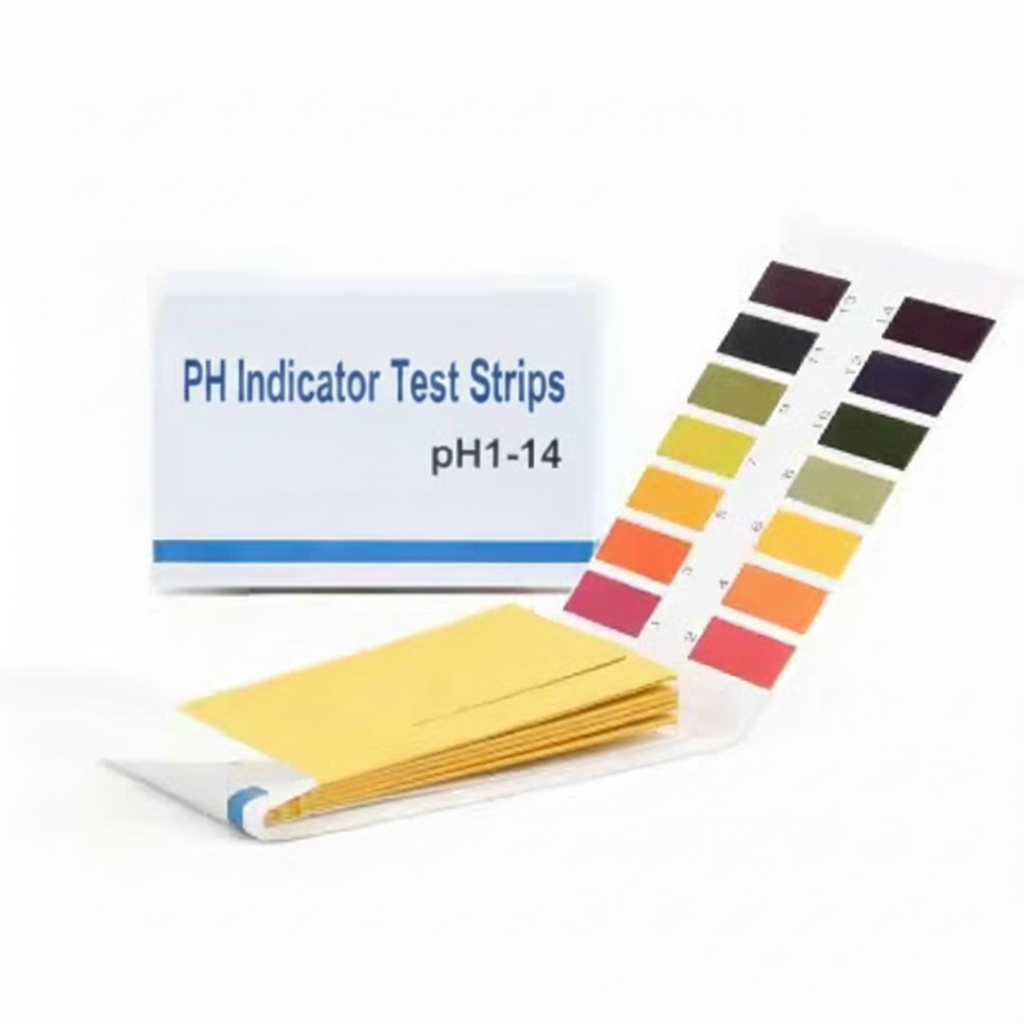
PH Indicator Test Strips in Pakistan
|
Item name |
pH test strips |
| Model No. |
LH-3101 |
Description
Feature:
1. Prepare the Indicator Solution
-
Chop the Cabbage: Chop about one-quarter of a head of red cabbage into small pieces.
-
Extract the Pigment: Place the chopped cabbage in a bowl or pot and cover it with boiling distilled water (about $500 \text{ mL}$).
-
Steep/Boil: Let the cabbage steep for about 30 minutes, or boil it gently for about 10–30 minutes to create a deep purple liquid. The boiling helps draw out the anthocyanins.
-
Strain: Strain the liquid through a strainer, coffee filter, or cheesecloth to remove all the solid cabbage pieces. The resulting liquid is your $\text{pH}$ indicator solution, which should be a dark purple/violet color (neutral $\text{pH}$ $\approx 7$).
2. Prepare and Dry the Strips
-
Soak the Paper: Submerge strips of white, acid-free paper (like coffee filters, blotter paper, or chromatography paper) into the concentrated purple cabbage solution. Ensure the paper is fully coated.
-
Dry: Carefully remove the strips and allow them to air-dry completely in a clean area, away from any acidic or basic vapors that could contaminate them.
-
Cut: Once completely dry, cut the paper into small, usable test strips.
-
Store: Store the dried strips in a closed, dry, dark container.
3. How to Use and Interpret
To test a liquid, dip one of your dried strips into the sample for a few seconds. The paper will change color based on the liquid’s $\text{pH}$:
| pH Range | Color Change | Condition |
| $\text{pH} < 7$ | Red or Pink | Acidic (e.g., vinegar, lemon juice) |
| $\text{pH} \approx 7$ | Purple or Violet | Neutral (e.g., pure water) |
| $\text{pH} > 7$ | Blue, Green, or Yellow | Basic / Alkaline (e.g., baking soda solution, ammonia) |
Reviews
There are no reviews yet.